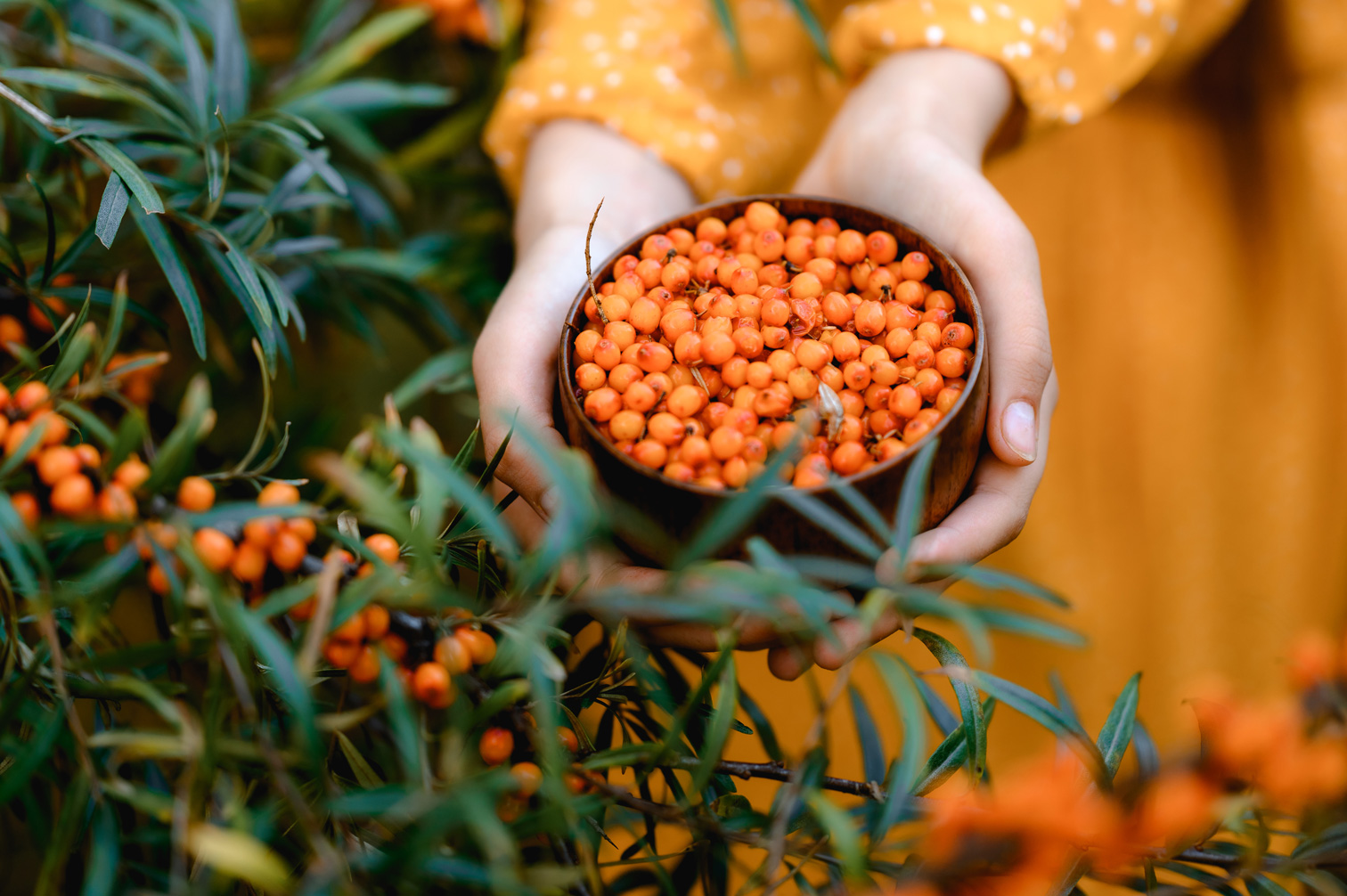
Sea buckthorn is a thorny deciduous shrub with bright yellow or orange berries that are extremely rich in a wide range of nutrients. This hardy plant is native to large parts of Asia where it grows in the Himalayan mountains and other rugged areas and where it is sometimes referred to as the holy fruit of the Himalayas. Sea buckthorn is also found in many other temperate regions of the world, including the U.K., France, Poland, Russia, Holland, and the Scandinavian countries. In fact, it is thought that it once grew all along the coastline from Northern Europe to the top of Africa as well as inland Asia and Siberia. It is variously known around the world as Sea buckthorn, Seaberry, Sandthorn, and Siberian pineapple.
The berries and leaves have been historically used to make juice, tea, or topical medicines in many different areas of the world 1 and its use may stretch back many hundreds if not thousands of years. Sea buckthorn is featured in both Indian Ayurvedic and traditional Chinese medicine while in Mongolia and Northern Kashmir it was traditionally used to make treatments for skin conditions. The medicinal value was recorded as early as the 8th century in the Tibetan medical classic rGyud Bzi.

In the UK, it is likely that our ancestors harvested it from around the coastline of the British Isles where it once grew extensively. Although it has disappeared from much of the English coastline, it can still be found growing wild along many coastal areas in Ireland.
As well as its use in traditional medicine, the plant has also been widely used in food and animal feed. In Europe, Sea buckthorn is mentioned in the writings of ancient Greek scholars such as Theophrastus and Dioscorides. To the Greeks, it was known as a remedy for horses. Both leaves and young branches were added to fodder to induce rapid weight gain and a shiny coat, and in fact, the name for the genus of Sea buckthorns (of which there are seven) is Hippophae, which means shining horse. In India, too, the leaves as well as seeds and fruit have been used as feed for livestock.
Sea buckthorn berries have a characteristic bitter and sour taste with a delicate aroma resembling that of the pineapple. It is for this reason that in Russia Sea buckthorn is also known as Siberian pineapple. In terms of taste, the berries are also sometimes compared to passion fruit, mangoes, and apricots.In many cultures, whole Sea buckthorn berries are pressed to make a juice that can have slightly bitter characteristics and a slight oiliness but also a citrus-like tanginess.

The berries can also be separated to produce a less oily juice or squash with the remaining part being used as an oil or as an ingredient in oil products. Traditionally, the most popular food prepared from the leaves of Sea buckthorn is a tea and a hot beverage is also brewed from the berries. Finally, antioxidant-rich jam can be obtained either from sea buckthorn fruit or mixed with other fruit such as papaya, grapes, or watermelon. The reputation of Sea buckthorn has grown globally since widespread cultivation began in Russia in the 1940s. Russian research led to the development of various Sea Buckthorn products that were utilized in the diet of Russian cosmonauts and in a cream for protection from cosmic radiation! In China, although traditional use stretches back for centuries, significant research and plantation establishment was only initiated in the 1980s. As a result of what was learned, Sea buckthorn squash was adopted as the official health drink of the Chinese athletes at the Seoul Olympics in 1992.
So what’s so special about this little orange fruit?
A lot of bang for your buckthorn…
As has been indicated already, Sea buckthorn is an exceptionally hardy plant. In fact, this remarkable shrub is able to withstand winter temperatures as low as −43 °C (−45 °F). It can survive in areas that are prone to drought, frost, and air pollution. Its toughness and strong root system mean that it is useful in many areas of the world not only because of the nutritious berries but also because the plant can help to prevent soil erosion. Like many other plants that are found in tough environments – such as Himalayan Goji berries or Maca root from the high Andes mountains in Peru – Sea buckthorn is a nutritional powerhouse rich in a wide range of antioxidants that are found in varying amounts in all parts of the plant 2.

Its berries are especially rich in vitamins A, K, and E and also provide considerable amounts of the minerals iron, calcium, magnesium, potassium, copper, and zinc. However, the most notable characteristic is their exceptionally high content of vitamin C. Remarkably, Sea buckthorn berries contain an average of 10x the vitamin C content of oranges with reported levels as high as 600 mg/100 g of fruit. Although the amount of vitamin C present in the fruit varies from species to species, all species are excellent sources of this important vitamin. Both the leaves and seeds are also a source of vitamin C. In addition to vitamins and minerals, the seeds and leaves also provide important nutrients called phytosterols. These include cycloartenol, campesterol, citrostadienol, and sitosterol. Phytosterols have many benefits, one of the most important being the fact that they can block cholesterol in your diet from being absorbed in your body 3. This is one way in which Sea buckthorn oil may help to reduce your risk of heart disease.
In addition to the vitamins and minerals, Sea buckthorn is rich in carotenoids, including lycopene, lutein, and zeaxanthin. Lycopene, which is also found in tomatoes, can be of benefit for the health of the prostate in men, and lutein and zeaxanthin are carotenoids that can be beneficial for eye health, particularly in relation to age-related macular degeneration (see our blog on eye health for more information). It is rich in the flavonoids isorhamnetin and quercetin and also in antioxidant polyphenols too. In addition to all of this, Sea buckthorn berries contain 18 amino acids out of a possible 22.
The various vitamins, minerals, and antioxidants in Sea buckthorn may help to protect your body against ageing and many illnesses, but the oil that can be sourced from Sea buckthorn seeds and berries is widely considered to be the most valuable component of this remarkable plant. That is because it contains high levels of an essential fatty acid called palmitoleic acid, better known as Omega-7.

Omega-7
Unusually for a berry or fruit, Sea buckthorn is very high in Essential Fatty Acids, which are also known as Omega fats or Omega oils. Interestingly, Sea buckthorn oil may also be one of the only plant foods known to provide all four Omega fatty acids 4.
Of particular interest is the fact that Sea buckthorn berries are the only known fruit source of Omega-7 (palmitoleic acid). This important essential fatty acid is found in low amounts in many foods, particularly sardines and macadamia nuts, but no source comes close to the little berries of the Sea buckthorn plant. This is significant because Omega-7 has anti-inflammatory properties that mean it helps to hydrate, heal, and protect our body’s largest organ — the skin. There are internal benefits too; Omega-7 assists with the overall health of our mucous membranes and supports a healthy gastrointestinal and digestive system. Omega-7, along with other fatty acids, can help to lower cholesterol, reduce inflammation, and improve overall cardiac function too.
Sea buckthorn oil is now extensively used in topical creams and bodycare products and is also widely available as a nutritional supplement in the West, and its effectiveness for a number of common health complaints is supported by a growing body of scientific research.
Sea buckthorn oil for skin health and wound healing
As we have already observed, Sea buckthorn has traditionally been used to aid skin regeneration, and now it is increasingly found in natural bodycare and skincare products. At Greenlife, we sell a range of Weleda products that are built around Sea buckthorn oil as a key ingredient. It also features in many hydrating natural bodycare products from top organic beauty brand Dr. Hauschka. The oil is also contained in many creams, shampoos, and other products for the treatment of eczema and contact dermatitis, such as Salcura’s Shampoo for dry, itchy, and flaky skin. This is because the many active components in the oil can protect cell membranes and enhance skin cell regeneration as well as increase skin hydration. Dehydrated skin is more prone to damage from environmental toxins, which is why it can be so helpful for eczema and atopic dermatitis 5. Palmitoleic acid is a component of skin used in burn treatment and wound healing, and Sea buckthorn oil has been reported to have preventive and curative effects against different types of gastric ulcers 6 as well as in the healing of burns 7. Look for skincare products containing Sea buckthorn if you are especially prone to dry skin. If you have eczema or dermatitis, then supplementing with the oil may prove additionally beneficial.

Sea buckthorn oil for menopausal intimate dryness
Sea buckthorn oil has been tested for its potential to ease the symptoms of menopause, such as vaginal atrophy and the thinning and drying of vaginal mucosa. It is especially useful for women who cannot tolerate oestrogen treatment. In one study, over 90 women were given Sea buckthorn oil supplements administered orally. After three months, the women showed improved vaginal health, including significantly better integrity of the vaginal epithelium – the inner lining of the vagina 8. If you are suffering from the symptoms of intimate dryness at any stage of life, then taking a supplement of Sea buckthorn, such as Pharma Nord Omega-7 capsules, may be helpful.
Sea buckthorn oil for dry eyes
Given the known positive effects of Sea buckthorn oil on skin and mucous membranes, researchers have investigated its possible effects on dry eye syndrome with promising results. A group of men and women with dry eye syndrome were given Sea buckthorn oil administered orally over a period of three months in autumn and winter 9. In addition to this promising research, the company Pharma Nord have gathered a number of glowing testimonials from customers using their Sea Buckthorn Omega-7 supplement for dry eyes. If you suffer from dry eyes, try 2 capsules twice per day for the first two weeks and 1 capsule twice per day thereafter.

Jon Inder
References:
- Pundir S, Garg P, et al. Ethnomedicinal uses, phytochemistry and dermatological effects of Hippophae rhamnoides L.: A review. J Ethnopharmacol (2021) 266:113434
- Yang B & Kallio H. Composition and physiological effects of sea buckthorn (Hippophae) lipids. Trends Food Sci. Technol. 2002;13:160–167.
- Jaśniewska A & Diowksz A. Wide Spectrum of Active Compounds in Sea Buckthorn (Hippophae rhamnoides) for Disease Prevention and Food Production, Antioxidants (Basel). 2021 Aug;10(8):1279.
- Gâtlan A & Gutt G. Sea Buckthorn in Plant Based Diets. An Analytical Approach of Sea Buckthorn Fruits Composition: Nutritional Value, Applications, and Health Benefits. Int J Environ Res Public Health. 2021 Sep;18(17):8986.
- Chandra S, Zafar R. Pharmacological and nutritional importance of sea buckthorn (Hippophae). The Pharma Innovation Journal 2018;7(5): 258-26
- Salehi B, Ouispe C et al. Phytosterols: From Preclinical Evidence to Potential Clinical Applications. Front Pharmacol. 2020;11:599959.
- Li T.S.C. Sea Buckthorn (Hippophaė rhamnoides L.): Production and Utilization. NRC Research Press; Ottawa, CA, USA: 2003. Taxonomy, natural distribution and botany; pp. 7–11.
- Ranjith A, Kumar K.S. et al. Fatty acids, tocols, and carotenoids in pulp oil of three sea buckthorn species (Hippophae rhamnoides, H. salicifolia, and H. tibetana) grown in the Indian Himalayas. J. Am. Oil Chem. Soc. 2006;83:359–364.
- Yang B, Kalimo K.O, et al. Effect of dietary supplementation with sea buckthorn (Hippophae rhamnoides) seed and pulp oils on the fatty acid composition of skin glycerophospholipids of patients with atopic dermatitis. J. Nutr. Biochem. 2000;11:338–340.
- Xing J, Yang B. et al. Kallio H.P. Effects of sea buckthorn (Hippophaë rhamnoides L.) seed and pulp oils on experimental models of gastric ulcers… Fitoterapia. 2002;73:644–650.
- Süleyman H, Demirezer L.Ö et al. Antiulcerogenic effect of Hippophae rhamnoides. L. Phyther. Res. 2001;15:625–627.
- Edraki M, Akbarzadeh A, et al. Healing effect of sea buckthorn, olive oil, and their mixture on full-thickness burn wounds. Adv. Ski. Wound Care. 2014;27:317–323.
- Larmo P.S, Yang B, et al. Effects of sea buckthorn oil intake on vaginal atrophy in postmenopausal women: A randomized, double-blind, placebo-controlled study. Maturitas. 2014;79:316–321.
- Larmo P.S., Järvinen R.L. et al. Oral sea buckthorn oil attenuates tear film osmolarity and symptoms in individuals with dry eye. J. Nutr. 2010;140:1462–1468.